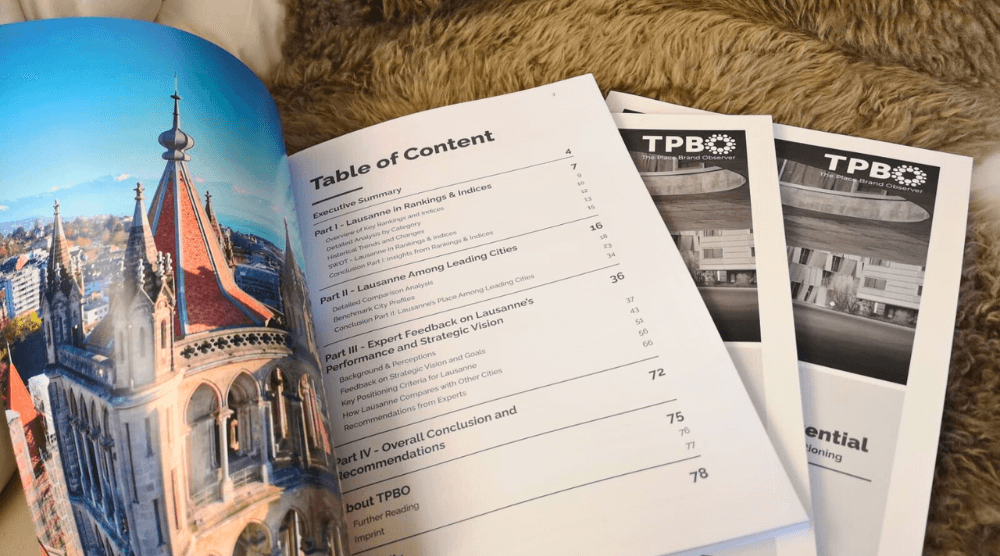
When Lausanne began working on its city brand, an important first question was how the city was positioned internationally, and how that perception compared with its own ambitions.
TPBO prepared a Place Brand Insights Report to provide an outside perspective. The analysis brought together international rankings, comparisons with ten peer cities and assessments from a panel of 27 experts in place branding, tourism and economic development.
Three perspectives on Lausanne
International rankings
We examined Lausanne’s position across rankings and indices covering tourism, talent attraction, economic competitiveness and sustainability. These provided an initial picture of the city’s relative strengths and areas that warranted closer attention, from its academic standing and cultural offer to the challenges associated with the cost of living.
Comparison with peer cities
Lausanne was compared with ten cities, including Basel, Munich, Aarhus and Utrecht. The aim was to put its relative position into context and identify where its profile was distinctive, where other cities offered useful points of comparison, and where its strengths could be more clearly articulated.
International expert perspectives
A panel of 27 experts contributed an additional perspective on Lausanne’s positioning. Their assessments touched on the city’s quality of life, academic and cultural assets, and Olympic heritage, as well as the challenge of developing a coherent and distinctive narrative.
Taken together, these three perspectives offered different ways of looking at the city: how it appears in established rankings, how it compares with selected peers, and how its strengths and positioning are interpreted by people familiar with the field.
An input to the brand development process
The report was intended to inform Lausanne’s early-stage brand development, not to prescribe a finished positioning. It provided a structured assessment of the city’s international profile and a basis for further discussion about its strengths, challenges and distinctive characteristics.
The findings also pointed to questions beyond communications alone. Affordability, for example, affects how a city is experienced by residents and prospective talent. And a distinctive brand narrative depends on more than a communications strategy: it needs to reflect the place itself and the people and institutions that shape it.
The report formed one input into Lausanne’s wider brand development process, alongside further work on audience perceptions and the development of a city brand strategy.
A closer look at place positioning
The Lausanne report illustrates how TPBO combines published rankings, peer comparisons and expert perspectives to examine how a place is positioned from the outside. The precise approach depends on the questions a place needs to address and the evidence available.
For cities, regions and countries working through similar questions, this kind of analysis can provide a starting point for a more informed discussion about positioning and reputation.