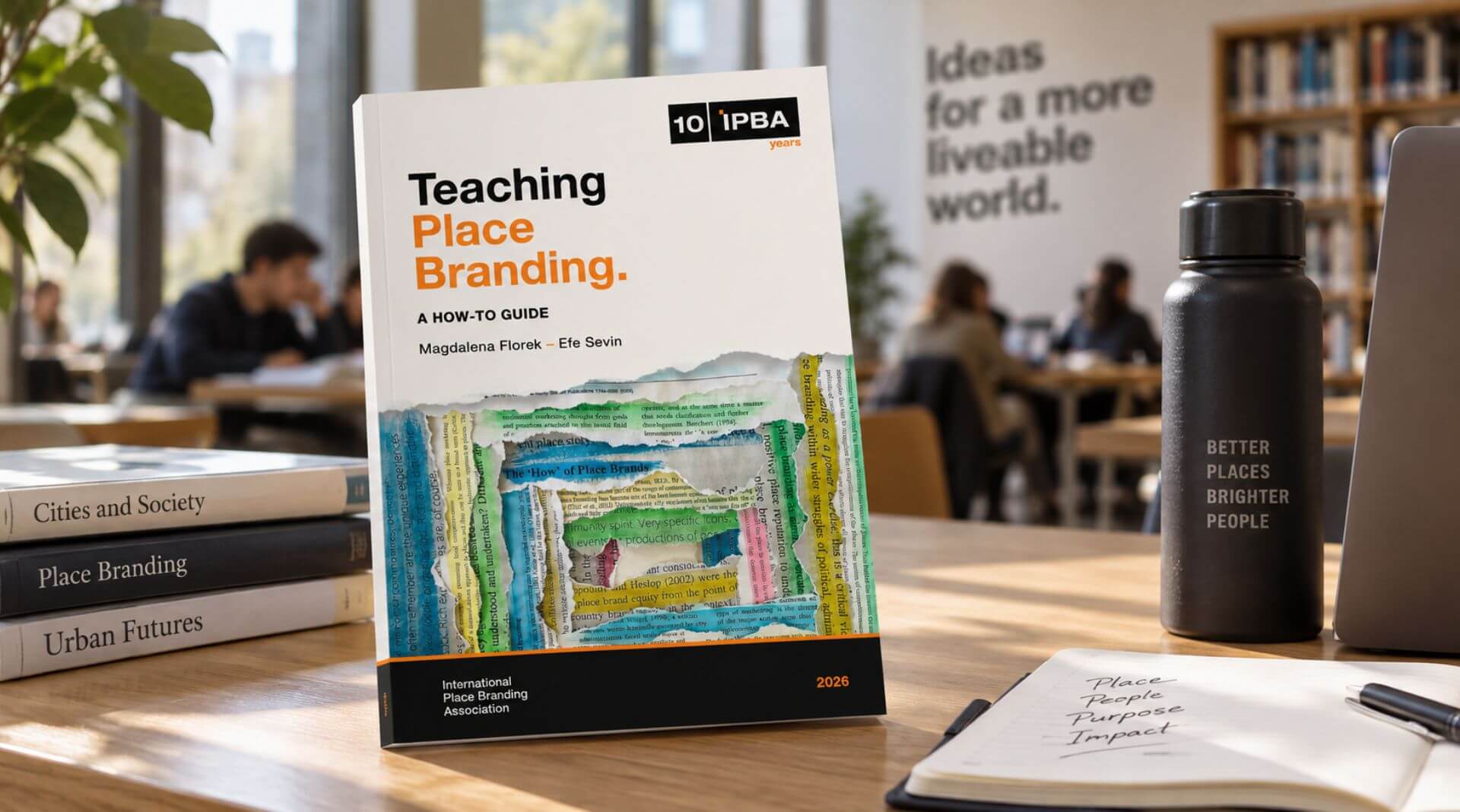
When Magdalena Florek and Efe Sevin first put together a short how-to guide for teaching place branding, it lived as a compact resource here on TPBO. Seven years on, they have rebuilt it into something far more ambitious: a guide of more than 120 pages, published by the International Place Branding Association to mark IPBA’s tenth anniversary.
The timing is not incidental. As Magdalena and Efe point out, the field has grown quickly, with new university courses, expanding training offers and wider interest across sectors and regions. That growth has sharpened a question practitioners and educators keep returning to: not just what place branding is, but how it should actually be taught.
That is the gap this guide sets out to fill, and its central argument is that place branding cannot be taught effectively through traditional marketing pedagogy alone. Marketing concepts still have their place, but they cannot capture places as social, political and cultural systems, with multiple stakeholders, conflicting interests, contested identities and outcomes that are long-term and often intangible.
Teaching such a complex topic means prioritising critical thinking, reflexivity and contextual sensitivity over formulaic solutions, and helping students grow comfortable with ambiguity rather than reaching for a template.
The read thread that runs through the guide is the insistence that place branding is a governance tool, not a promotional one.
Branding decisions shape spatial development, social inclusion, cultural representation and democratic participation, so teaching it carries real consequences. Another recurring theme is the need to correct a persistent misconception: that place branding is about logos, slogans and campaigns.
Magdalena and Efe want educators to draw clear distinctions, between place branding and place marketing, and between branding as communication and branding as governance, and to keep the field’s interdisciplinary character intact rather than letting whichever department happens to host the course flatten it into a single perspective.
For anyone designing a course or a training programme, the guide offers a practical structure. Alongside the pedagogical framing, it moves through fifteen thematic areas that map place branding: from brand image and identity, research foundations, stakeholder management and communication, through to digital place branding, placemaking, performance measurement, ethics, sustainability and the future of it all. It reads as much as a curriculum scaffold as a manifesto, with attention throughout to the uniqueness of individual places and the danger of teaching transferable “best practice” without critical discussion.
It is a genuinely useful document, and IPBA has made it free to download. For educators, trainers and anyone thinking seriously about how the next generation of place branding practitioners is formed, it is well worth the time.
Download “Teaching Place Branding: A How-To Guide”
The guide was written by Magdalena Florek (IPBA Education Director) and Efe Sevin (Towson University), with a foreword by IPBA chairman Robert Govers.