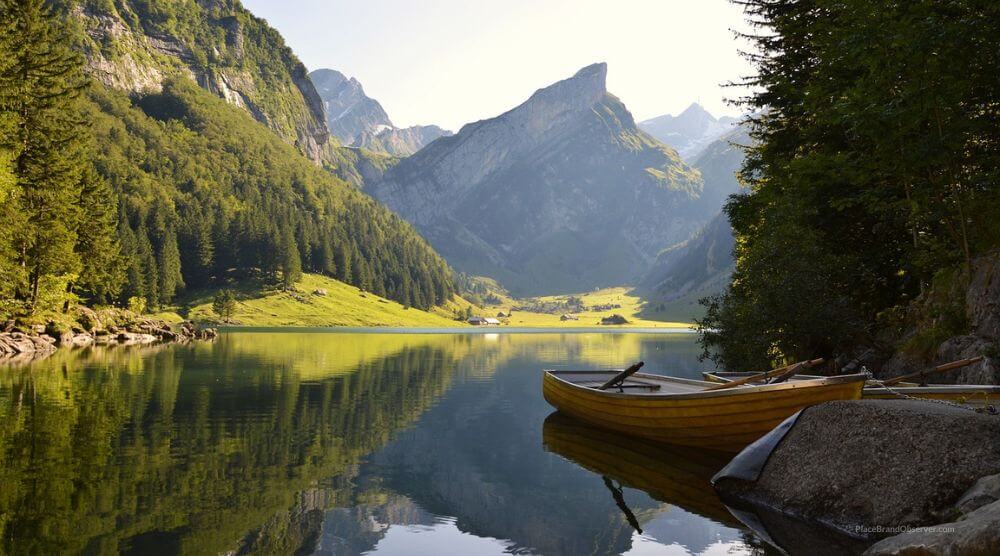
Switzerland sits at or near the top of most international rankings, from innovation and competitiveness to soft power and quality of life. Its reputation for stability, precision and quality, often summed up as Swissness, is among the best known of any country.
This profile looks at how Switzerland is positioned, how it is read from outside, and where the two pull apart, drawing on the major rankings alongside our own coverage of the country since 2015.
Country Brand Strength
Switzerland has been placed in the top ten of Brand Finance‘s Global Soft Power Index and of the Anholt-Ipsos Nation Brands Index in recent editions, and first in U.S. News’ Best Countries ranking. It scores highest on governance, ethical standards and stability.
The country is promoted by several bodies with separate mandates: Presence Switzerland for the country’s image abroad, Switzerland Tourism for visitors, and Switzerland Global Enterprise for exports and investment. Nicolas Bideau, head of Presence Switzerland, spoke to us about Brand Switzerland and the role of culinary diplomacy. Martin Nydegger of Switzerland Tourism described a national marketer funded by its own regions that was never only a promoter.
As early as 2015, Renaud Vuignier pointed to a growing gap between the values of Swissness and some of the country’s political developments, and the risk this posed to its credibility.
Economic Position
Switzerland has ranked among the top three of IMD’s World Competitiveness Ranking for years and has led the Global Innovation Index and the European Innovation Scoreboard. Patrik Wermelinger and Sirpa Tsimal of Switzerland Global Enterprise told us how the country is promoted to investors as an innovation location.
That work has itself become a political question. The federal budget proposed for location promotion from 2028 is lower than for the current period, and some argue that Switzerland is attractive enough without state-supported promotion abroad. At the same time, around 70 per cent of executives in a recent study by McKinsey and the Swiss-American Chamber of Commerce say the country has fallen behind other business hubs on regulation, taxes and infrastructure. Our recent look at Swiss location marketing found that cantons and cities organise this work in almost every possible way.
Appeal to Talent
Switzerland has led INSEAD’s Global Talent Competitiveness Index, with particular strength in enabling and retaining talent, and has three universities in the global top 100. Expat surveys place it only mid-table overall: high marks for safety, salaries and environment, weaker ones for cost and for settling in.
Claude Wagner of FHNW told us that the country’s cultural and linguistic diversity helps attract companies and wealthy individuals from abroad, while cities have become unaffordable for many residents and protectionist tendencies are growing.
Sustainability and Quality of Life
Switzerland ranks in the top ten of the Environmental Performance Index, the Global Peace Index and the World Happiness Report, and among the leading countries in the Sustainable Development Report.
Much of that work happens at regional level, in places we have covered such as Graubünden, Entlebuch and Valposchiavo, where sustainability is built into how destinations are run rather than added as a message.
What Stands Out
Few countries have a reputation as well established as Switzerland’s, and few have rankings that back it up as consistently. That strength is also why promoting the country abroad has become contested at home.
In TPBO’s reading, the open question is less how Switzerland is seen than who keeps that picture current. The work is spread across federal bodies, cantons, regions and cities, while companies report that some of the advantages behind the reputation are under pressure. As Wagner puts it, place branding cannot talk a problem away.
What Switzerland says about itself and what people find when they look it up are largely the same: stability, quality and innovation.
Swissness is one of the few country attributes that people recognise without explanation. Quality of life, also part of the message, is shared with many others.
Innovation, competitiveness and talent rankings confirm the claims year after year, though executives now report pressure on regulation, taxes and infrastructure.
Positions are relative to the places in TPBO’s editorial record and based on public material only.
Want the same reading for your own place? Request a free Positioning Check →
From Our Archive
- 2026Who positions the place? A question for Swiss location marketing
- 2026Claude Wagner on the fragility and future of place branding in Switzerland
- 2021Sirpa Tsimal on Switzerland’s approach to FDI and the power of innovation
- 2021Switzerland country showcase
- 2020Patrik Wermelinger on investment promotion and Switzerland as innovation location
- 2019Switzerland tops most innovative countries ranking
- 2018Martin Nydegger on tourism sustainability strategies and trends in Switzerland
- 2017Nicolas Bideau on Brand Switzerland, nation branding and culinary diplomacy
- 2017How transparency impacts place attractiveness: example Switzerland
- 2015Renaud Vuignier’s place branding country profile of Switzerland
About this profile. We combine the main international rankings, including Brand Finance‘s Global Soft Power Index, with our own interviews and reporting. Rankings change every year, so positions are described in broad terms. See the rankings and indices we follow, or explore our other country profiles.