
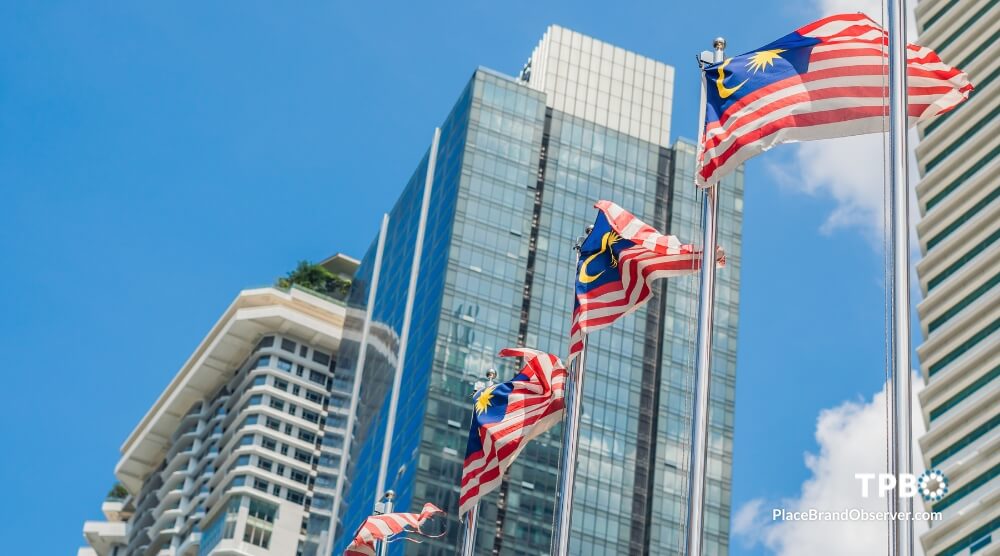
Malaysia combines an established manufacturing base with a diverse culture, cities such as Kuala Lumpur and Penang, and landscapes from Langkawi to Borneo. It is one of Southeast Asia’s most experienced investment destinations, and one of the most welcoming countries for people who move there.
This profile looks at how Malaysia is positioned, how it is read from outside, and where the two pull apart, drawing on the major rankings alongside our 2026 reporting on investment attraction in Southeast Asia.
Country Brand Strength
Malaysia placed in the mid-thirties of Brand Finance‘s Global Soft Power Index in 2024, up four places. US News ranked it in the high thirties overall in 2023, but twelfth in the world for being open for business. Bloom Consulting placed it in the low twenties globally for its trade brand and the mid-twenties for its tourism brand in 2022-2023.
Economic Position
IMD placed Malaysia in the high twenties in 2023, and seventh in the world for economic performance. Its investment agency, MIDA, dates from 1967, and the OECD counts it among the agencies in the region whose autonomy gives them some protection from political change.
In our 2026 review of five Southeast Asian economies, Malaysia stood out for two reasons. Its New Incentive Framework, introduced for manufacturing in March 2026, links incentives to measurable outcomes such as higher-value jobs, domestic supply chains and sustainability. And it reports what approvals deliver: MIDA says 84.9% of manufacturing projects approved between 2021 and 2025 have reached some stage of implementation. With Singapore, it has also created the Johor-Singapore Special Economic Zone, where Singapore-based companies committed more than S$5.5 billion in 2025.
In our series on investment attraction, two of six contributors named Johor as a place to watch, alongside Penang’s new Silicon Island and Sarawak, whose renewable energy is drawing data centres.
Appeal to Talent
Malaysia was in the top five of Expat Insider in 2023, with especially high scores for housing, language, personal finance and making friends. Safety was its only weak area. INSEAD’s Global Talent Competitiveness Index 2023 placed it in the low forties, and none of its universities was in the global top 100 of the Times Higher Education ranking for 2024.
Sustainability and Quality of Life
Malaysia is in the top twenty of the Global Peace Index 2023. Its environmental results are weaker: it placed around 130th in the Environmental Performance Index 2022, though its score improved over the previous decade, and around eightieth in the Sustainable Development Report 2023. The World Happiness Report 2024 placed it in the high fifties.
What Stands Out
Malaysia makes one of the most concrete investment cases in our record. It tells investors what it expects from them and reports what approved projects have delivered, which few countries do.
Its image abroad is less clear than its economic record. Newcomers rate it highly, but in the perception rankings it sits in the middle, and its environmental results lag well behind its industrial ambitions.
Investors understand Malaysia’s offer well. The wider public knows it less clearly than its economic weight would suggest.
The Johor-Singapore zone and its outcome-based incentives set it apart. Its target sectors are shared with most of its neighbours.
Published implementation results, competitiveness and expat satisfaction back the brand. Environmental results weaken it.
Positions are relative to the places in TPBO’s editorial record and based on public material only.
Want the same reading for your own place? Request a free Outside View →
From Our Archive
- 2026How five Southeast Asian economies position themselves to attract investment
- 2026What six investment rankings tell us about India and Southeast Asia
- 2026Investment attraction: six expert views
- 2017Current state of place branding practice in Asia
About this profile. We combine the main international rankings, including Brand Finance’s Global Soft Power Index, IMD’s World Competitiveness Ranking and INSEAD’s Global Talent Competitiveness Index, with our own interviews and reporting. Rankings change every year, so positions are described in broad terms. See the rankings and indices we follow, or explore our other country profiles.