
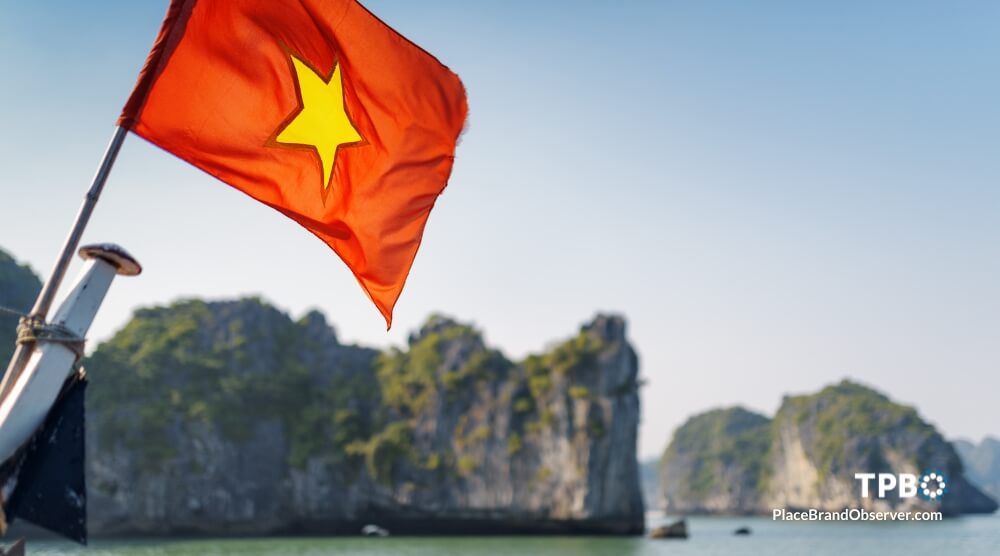
Vietnam is known abroad for its landscapes, its food and cities such as Hanoi and Ho Chi Minh City, and for its role in global manufacturing. Its government now wants it to be seen as a centre for innovation and high-tech industry too.
This profile looks at how Vietnam is positioned, how it is read from outside, and where the two pull apart, drawing on the major rankings alongside our 2026 reporting on investment attraction in Southeast Asia.
Country Brand Strength
Vietnam rose from the high sixties to the low fifties of Brand Finance‘s Global Soft Power Index in 2024. In Brand Finance’s Nation Brand Value ranking for 2026, it was one of several emerging economies whose soft power rose while their brand value fell, mostly for economic reasons such as inflation and weaker currencies. Bloom Consulting placed it around thirtieth globally for its trade brand in 2022-2023.
Economic Position
In our 2026 review of five Southeast Asian economies, we found Vietnam making the most explicit shift. A government resolution of June 2026 aims to make it one of Asia’s leading centres for foreign investment, innovation, research and high-tech manufacturing, and to move from attracting investment by volume to building the contribution of foreign companies, from technology transfer to local suppliers.
The figures show strong momentum, though they measure different things. In the first nine months of 2026, Vietnam recorded US$50.4 billion in attracted foreign investment, up 76%, and disbursed investment reached a five-year high. Singapore was the largest reported investor. Its Foreign Investment Agency dates only from 2017.
In our series on investment attraction, Dominic Mason of Sedgwick Richardson observed that property developers are now shaping how Vietnamese places present themselves to investors, with large townships and mixed-use projects well beyond Ho Chi Minh City and Hanoi.
Appeal to Talent
Expat Insider placed Vietnam in the top fifteen in 2023 and first in the world for personal finance, with high scores for friendliness. INSEAD’s Global Talent Competitiveness Index 2023 placed it in the mid-seventies, with keeping talent its weakest area, and none of its universities was in the global top 100.
Sustainability and Quality of Life
Vietnam sits in the low forties of the Global Peace Index and rose to the mid-fifties of the World Happiness Report in 2024. Its environmental results are the weakest point: it placed near the bottom of the Environmental Performance Index 2022, and in the mid-fifties of the Sustainable Development Report 2023.
What Stands Out
Vietnam is trying to change what it is known for, from a place where things are made to a place where they are developed. Its investment figures and its new policies give that ambition some weight.
Its image is rising too, but from a lower base. Environmental results and the ability to keep skilled people are where the gap between ambition and reality is widest.
Vietnam is read as a manufacturing base and a destination. Its ambition to become an innovation centre is not yet part of how it is seen.
Its food, landscapes and cities are its own. Its target industries are shared with most of its neighbours.
Investment flows and clear policy goals back the brand. Environmental results and the ability to keep talent weaken it.
Positions are relative to the places in TPBO’s editorial record and based on public material only.
Want the same reading for your own place? Request a free Outside View →
From Our Archive
- 2026How five Southeast Asian economies position themselves to attract investment
- 2026Investment attraction: six expert views
- 2026Most valuable nation brands in 2026
- 2026What six investment rankings tell us about India and Southeast Asia
About this profile. We combine the main international rankings, including Brand Finance’s Global Soft Power Index and Nation Brand Value and INSEAD’s Global Talent Competitiveness Index, with our own reporting. Rankings change every year, so positions are described in broad terms. See the rankings and indices we follow, or explore our other country profiles.