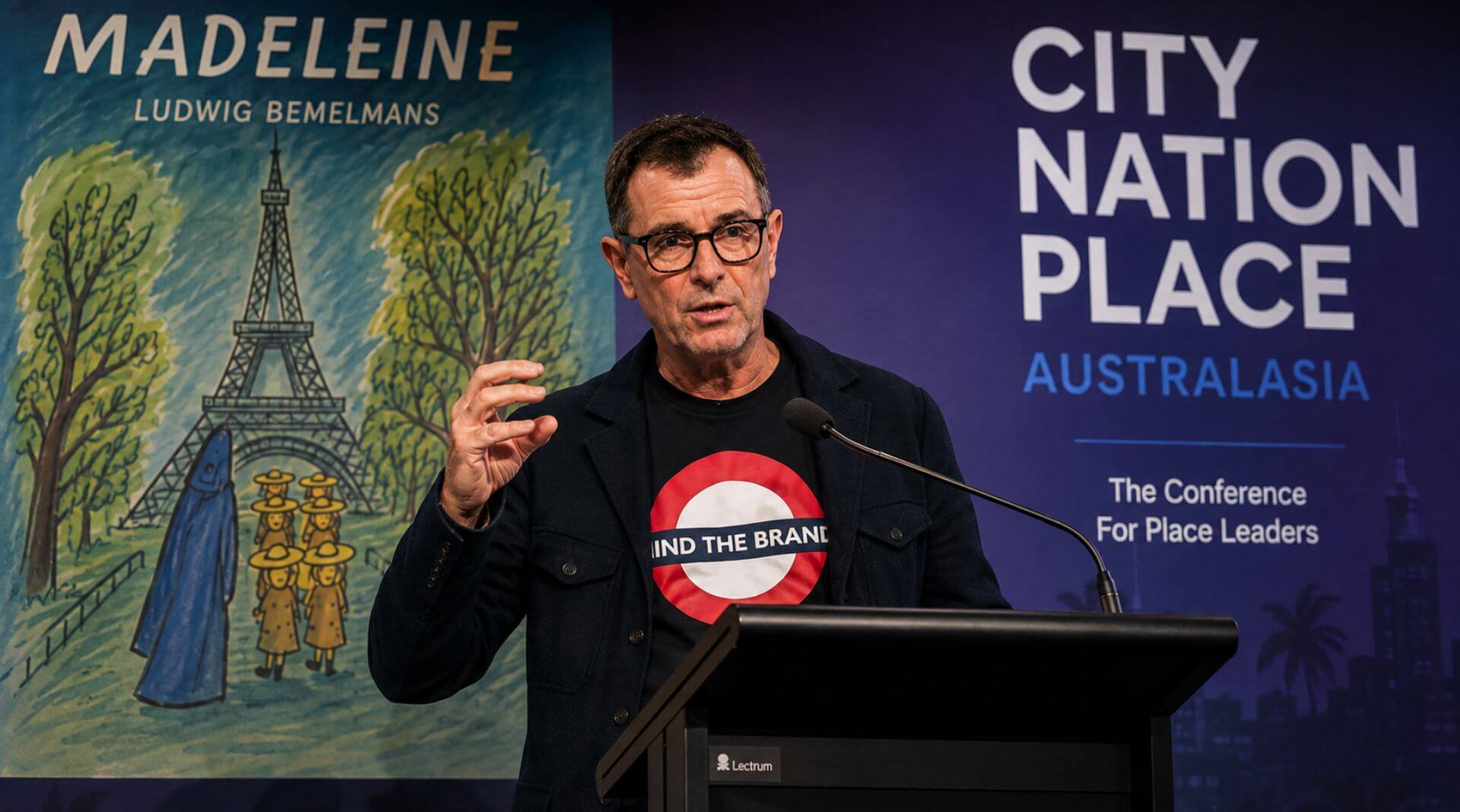
Most conferences give you one good lightbulb moment, if you’re lucky. At last week’s City Nation Place Australasia get together, Stu Speirs found his in a French children’s book. Read his reflections below.
The good folk at City Nation Place teamed up with our own Mainstreet Australia to deliver City Nation Place Australasia on the Gold Coast on 6 and 7 August. It was a typically warm, collegiate gathering of like-minded people, all looking to improve the lives of those who live in the places they love.
When it comes to conferences these days, I increasingly find myself leaving with one, maybe two lightbulb moments. As I boarded my plane at Coolangatta Airport after two days of having the grey matter worked over, this held true again.
There was something to glean from every presentation, but one in particular stayed with me. David Vaassen, founder and CEO at Brandkit.com, opened his session by reading us the first passages of the iconically French children’s book Madeline. It is so French. And that, in a way, is the point: it passes the ultimate test of great place branding by answering an emphatic “Yes!” to the question “Is this French?” You know it in your bones before anyone has told you why.
That opening flowed into a presentation about how the impression of a place is most often seeded and nurtured long before any intentional marketing or place branding exercise gets the chance.
Having established that, David turned to the critical importance of being different, authentic and true to oneself in the age of AI. Two reasons stood out (apologies if I’ve mangled anything, David; this is how my brain synthesised it):
First, search engines are increasingly rewarding content that is genuinely useful and original, and demoting the derivative and the generic. Not only material suspected of being AI-written, but anything that reads like a copy of what’s already out there.
Second, being true to yourself will increasingly surface in the sources Large Language Models scrape to build their answers. We’re talking self-owned media such as websites and social channels, and the forums where actual humans express opinions in some depth, Reddit being the obvious one.
In short: there’s a pressing need to uncover, tell and re-tell your place’s stories online.
That excites me, because in theory it reinforces the value of good old-fashioned storytelling with real people and real names at its heart. It also sobers me, because it feeds the zeitgeist that demands we constantly “feed the beast”. Then again, if what we’re feeding it is other people’s stories rather than our own invented content, we don’t have to feel like we’re manufacturing anything. We’re just uncovering what’s already there and giving it a platform.
The need to be true to oneself is the one constant place branding will always know, whatever changes come. What David’s session crystallised for me is how critical it will be to understand and represent what is genuinely different about your place in the weeks, months and years ahead.
We’re heading for a world, not far off, where we’ll ask our glasses a question and they’ll answer. With that on the horizon, what stories do you actually know about the corners, plazas, squares, boulevards, buildings and streets of your place? Who made them, lived in them, worked in them? If you asked those not-yet-existent glasses to explain what you’re looking at, would they have a story to tell?
If not, better get digging, unearthing, telling and retelling.
Stu Speirs is a TPBO Correspondent based in Australia, focused on place branding, event management and destination strategy across the region, supporting communities through his company Silver Lining Strategy.
The Gold Coast, the conference’s host city, features in a recent TPBO showcase on how Brand Gold Coast built its place brand from the inside out, read it here. It also appears in the 2026 Place Brand Leaders Yearbook, which we had on hand in print at the event: a rare treat, as it’s normally available only as a PDF via the website.