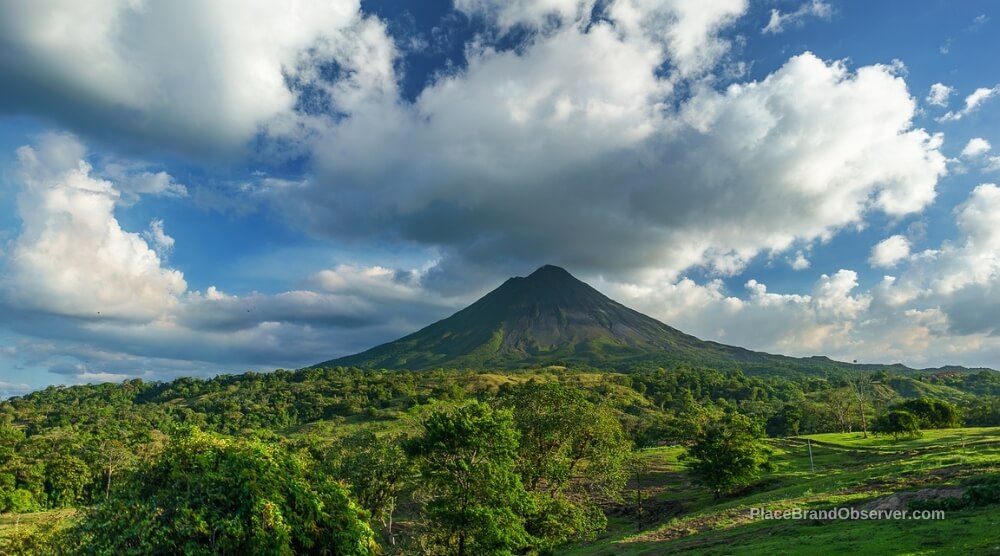
Costa Rica is one of the most often cited country brands in TPBO’s record. Its reputation for nature, peace and sustainability is built on decisions taken decades ago, from abolishing its army to restoring its forests, and its country brand, essential COSTA RICA, has kept the same core message for more than twelve years.
This profile looks at how Costa Rica is positioned, how it is read from outside, and where the two pull apart, drawing on the major rankings alongside our own coverage of the country since 2016.
Country Brand Strength
Costa Rica is regularly among the leading Latin American countries in brand and reputation rankings, including Brand Finance‘s Global Soft Power Index, where its sustainability credentials stand out.
Daniel Valverde Bagnarello told us how essential COSTA RICA became one of the most recognised country brands of its size, and later how it linked the brand to climate action. Its credibility, as Adriana Acosta of PROCOMER explained, rests on governance: the brand brings together the institutions responsible for investment, trade, foreign affairs and tourism, so that the story stays tied to real policies.
Economic Position
Costa Rica has moved over three decades from low productive complexity to hosting more than 1,000 multinational companies, including some 90 in medical devices and 13 in semiconductors. Acosta told us that the country prioritises knowledge-intensive sectors and investors who value talent and sustainability, rather than attracting investment of any kind.
Investment promotion is measured by projects attracted and the quality of jobs created, and the brand team commissions perception studies market by market to decide where to compete.
Appeal to Talent
Acosta describes talent as national infrastructure, the result of universal education introduced in the nineteenth century and the decision to abolish the army more than 75 years ago. The country stands out in its region for bilingual talent and for experience in advanced manufacturing. Its next challenge, she says, is keeping skills development in step with technologies such as AI.
Sustainability and Quality of Life
Sustainability in Costa Rica is a development model more than a message: a largely clean electricity system, environmental standards for production, and incentives that helped restore forest cover. Glenn Jampol described the country’s position as a leading destination for ecotourism and responsible travel.
What Stands Out
Costa Rica’s brand is one of the few in our record where the main claim is backed by policies older than the brand itself. Sustainability was national strategy long before it was a message.
In TPBO’s reading, the less familiar part of the story is the economic one. Costa Rica is known abroad for nature and ecotourism, much less for medical devices and semiconductors. The brand’s task now is to make that second story as recognisable as the first, without letting it dilute what made the country distinctive in the first place.
The sustainability story comes through clearly. The investment story, from medical devices to semiconductors, is much less visible from outside.
Many countries claim sustainability. Few can point to a history like abolishing the army to invest in education.
Clean electricity, restored forests and more than 1,000 multinationals back the claims, and the brand tracks jobs and projects rather than reach.
Positions are relative to the places in TPBO’s editorial record and based on public material only.
Want the same reading for your own place? Request a free Positioning Check →
From Our Archive
- 2026Adriana Acosta on Costa Rica’s strategy to attract sustainable, high-value investment
- 2026Costa Rica country showcase
- 2023Aglaé Perrin on nation branding in Latin America and the Caribbean
- 2023Adriana Acosta on ten years of the essential COSTA RICA country brand
- 2021On New Zealand and Costa Rica: Place Brand Leaders podcast
- 2020Daniel Valverde on Costa Rica’s country branding strategy
- 2019Daniel Valverde Bagnarello on how essential COSTA RICA became a success story
- 2016Destination check: tourism sustainability in Costa Rica
About this profile. We combine the main international rankings, including Brand Finance‘s Global Soft Power Index, with our own interviews and reporting. Rankings change every year, so positions are described in broad terms. See the rankings and indices we follow, or explore our other country profiles.