
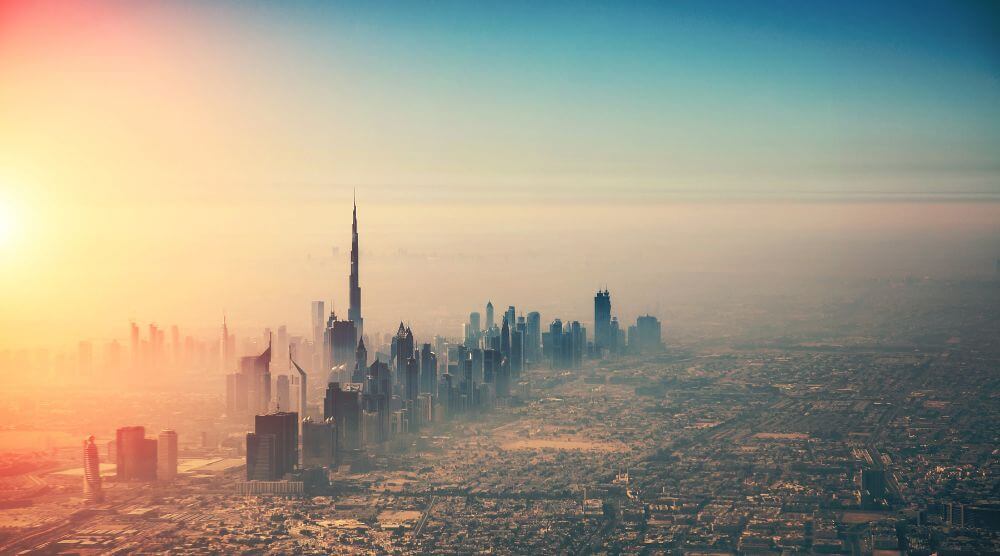
Dubai is the largest city of the United Arab Emirates and one of the world’s leading hubs for travel, trade and business. In a few decades it has built a global profile through ambitious architecture, major events such as Expo 2020 and COP28, and a population drawn from around the world.
This profile looks at how Dubai is positioned, how it is read from outside, and where the two pull apart, drawing on the major rankings alongside our own coverage.
City Brand Strength
Dubai is one of the world’s strongest city brands. Brand Finance‘s Global City Index placed it fifth in 2024, alongside London, New York, Paris and Tokyo. Resonance’s World’s Best Cities placed it in the global top ten from 2020 to 2023 and around 13th in 2024 and 2025. Research presented at City Nation Place Global 2024 put it third in the world for international arrivals in 2023, after Istanbul and London.
Economic Position
Dubai’s economic results now match its brand. It entered the top 50 of Oxford Economics’ Global Cities Index 2026, which named it a City to Watch and gave it one of the highest scores for human capital, though a much lower score for governance. The Global Financial Centres Index placed it 12th in 2025, and the Innovation Cities Index 14th in 2023.
Appeal to Talent
Dubai attracts international professionals with its connections, safety and lifestyle. Numbeo placed it in the high eighties for quality of life in 2025, and Mercer in the low eighties for quality of living in 2024. For international staff, it is among the more expensive cities, around 15th in Mercer’s cost of living ranking.
Urban Sustainability
IMD’s Smart City Index 2026 placed Dubai sixth in the world and first outside Europe. In our briefing, we noted that Dubai and Abu Dhabi show how state-directed investment can build civic confidence when services are consistently good. IESE’s Cities in Motion Index placed it in the mid-forties in 2025, a large improvement, though with weaker environmental results. Heat and resource use are its main long-term pressures.
What Stands Out
Dubai has done what few cities have: built a global brand on purpose, and then backed it with results in finance, innovation and city services.
Its weaker side is the environment, along with governance scores that lag behind its human capital. These are the measures most likely to shape how the next generation of investors and talent reads the city.
Dubai is read much as it presents itself: ambitious, connected and built for business.
Its skyline, scale of ambition and role as a crossroads give it an identity of its own.
Finance, innovation and smart city results back the brand. Environmental results are the weaker point.
Positions are relative to the places in TPBO’s editorial record and based on public material only.
Want the same reading for your own place? Request a free Outside View →
From Our Archive
- 2026Global Cities Index 2026: the top barely moves, but the profiles behind it tell more
- 2026IMD Smart City Index 2026: what it means for urban leaders
- CityAbu Dhabi: city profile
- CountryUnited Arab Emirates: country profile
About this profile. We combine the main international rankings, including Brand Finance‘s Global City Index, Resonance’s World’s Best Cities, Oxford Economics’ Global Cities Index, the Global Financial Centres Index and IMD’s Smart City Index, with our own reporting. Rankings change every year, so positions are described in broad terms. See the rankings and indices we follow, or explore our other city profiles.