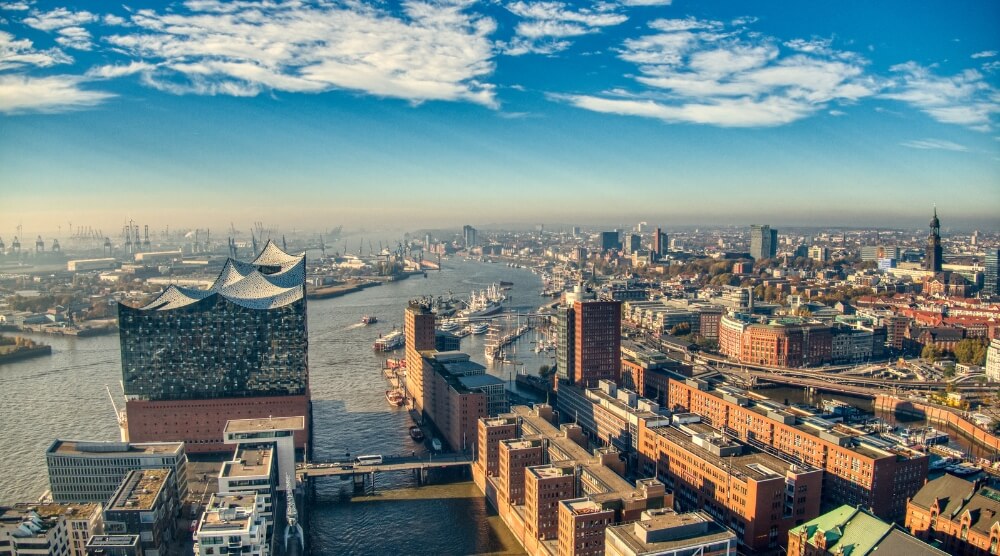
Hamburg, Germany‘s second-largest city, has managed its city brand in a coordinated way for longer than most European cities. It is widely seen at home as one of Germany’s strongest city brands, and much less known further afield.
This profile looks at how Hamburg is positioned, how it is read from outside, and where the two pull apart, drawing on the major rankings alongside our own coverage of the city since 2015.
City Brand Strength
In the global brand and reputation indices, Hamburg sits well below its standing in the sustainability and quality of life rankings. It has placed around 40th in Brand Finance‘s Global City Index and has fallen back in recent editions of Resonance’s World’s Best Cities.
Hamburg Marketing does not read this as an image problem. Stefan Nöthen, who has led the Hamburg brand since 2013, told us that people who know the city see it in a remarkably consistent way: open, maritime, with a high quality of life. The difficulty is that outside Europe too few people know it at all. Icons such as the port and the Elbphilharmonie travel more easily than the rest of the city.
The brand itself is not new. Thorsten Kausch described to us how Hamburg moved from destination marketing to managing the city as one brand in 2004, with Hamburg Marketing set up as one among equals next to the other organisations that promote the city.
Economic Position
Hamburg’s economic results are solid without being prominent. It sits in the forties of the Global Financial Centres Index and has moved up and down in the innovation rankings.
The promotion behind it is unusually joined up. Hamburg Marketing, Hamburg Tourism and Hamburg Invest work within one holding structure, so that investors, visitors and talent meet the same brand. Nöthen names the United States, the United Kingdom and Scandinavia as priority markets, with knowledge-based companies, start-ups and investors linked to the city’s clusters as the main business audience.
Appeal to Talent
Hamburg ranks in the upper half of Mercer’s and Numbeo’s quality of life measures, and its living costs remain moderate for a northern European city, though they have risen in recent years.
International talent, especially highly qualified and mobile professionals, is a growing priority for Hamburg Marketing. Nöthen’s point applies here too: the city’s quality of life is part of its profile among those who know it, and less visible to those who don’t.
Urban Sustainability
Sustainability is where Hamburg ranks highest. It placed seventh in the 2024 Arcadis Sustainable Cities Index and has held a place in the top twenty of IESE’s Cities in Motion Index in recent editions.
Sebastian Zenker, who worked with the city on how to measure its branding, pointed to another long-running task: Hamburg’s relationship with its surrounding metropolitan region, which offers the space, people and nature the city needs for its own proposition.
What Stands Out
Hamburg has a brand that has stayed consistent for twenty years and is well understood by the people who know the city. Its sustainability results are stronger than its reputation abroad would suggest.
In TPBO’s reading, the gap is one of reach rather than identity. Nöthen describes the shift Hamburg is now making as one from “Hamburg says” to “Hamburg demonstrates”, and the sustainability rankings are one of the clearest pieces of proof the city has to show.
Those who know Hamburg see it much as the city describes itself. Abroad, mostly the port and the Elbphilharmonie come through.
Hamburg leads with the water, its contrasts and a certain understatement, rather than the claims most cities make.
The city’s claims are backed by results, above all in sustainability, where it ranks among the global top ten.
Positions are relative to the places in TPBO’s editorial record and based on public material only.
Want the same reading for your own place? Request a free Positioning Check →
From Our Archive
- 2026Stefan Nöthen on building Hamburg’s international awareness
- 2018Thorsten Kausch on Hamburg, MICE and the future of city marketing
- 2017How Hamburg moved from destination marketing to strategic city branding
- 2017City branding challenges: four lessons from Hamburg
- 2017Peter Pirck on city branding practices and trends in Germany
- 2017Petra Trimborn on destination branding and sustainability in Germany
- 2015Sebastian Zenker on place marketing and city branding
About this profile. We combine the main international rankings, including Brand Finance‘s Global City Index and Resonance’s World’s Best Cities, with our own interviews and reporting. Rankings change every year, so positions are described in broad terms. See the rankings and indices we follow, or explore our other city profiles.