
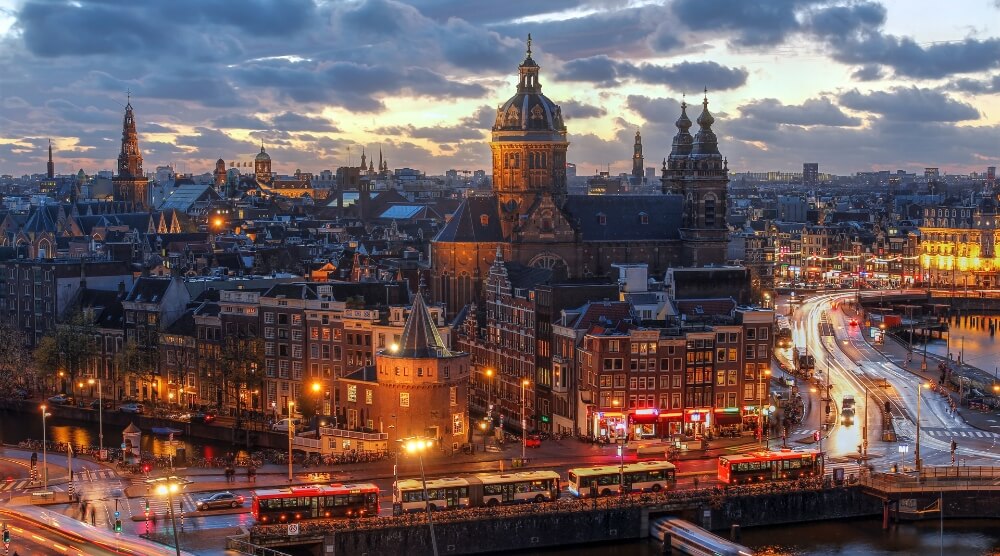
The Netherlands is a small, densely populated country with an economy and a reputation well above its size. Abroad it is known first through Amsterdam, while much of its place branding work happens in its regions and mid-sized cities.
This profile looks at how the Netherlands is positioned, how it is read from outside, and where the two pull apart, drawing on the major rankings alongside our own coverage of the country and its cities since 2015.
Country Brand Strength
The Netherlands sits just outside the top ten of the main reputation indices. It placed twelfth in the 2026 Anholt Nation Brands Index and in the mid-teens of Brand Finance‘s Global Soft Power Index in recent editions.
Below the national level, our record shows an unusual number of Dutch places working on their own brands. Geerte Udo told us that I amsterdam was set up in 2004 as a public-private foundation, planned from the start as a long-term effort, and now works with some 750 partners. Gwen Zuring described how Brabant decided against a logo of its own and instead helps partners make their activities fit the region’s brand values. Mid-sized cities such as Den Bosch, Tilburg and Venlo have presented their brands in TPBO showcases.
Economic Position
The Netherlands was in the top five of IMD’s World Competitiveness Ranking in 2023, among the leaders for business efficiency and infrastructure.
Much of that economic weight sits outside Amsterdam. Zuring told us that Brabant is the second-largest economic region in the country and the source of more than half of all Dutch patent applications, yet national media tend to pick their stories from Amsterdam, Rotterdam and The Hague. Our Brainport Eindhoven showcase follows how a Philips company town became a technology region of 21 municipalities, home to ASML and thousands of smaller firms.
Appeal to Talent
The Netherlands ranked fifth in INSEAD’s Global Talent Competitiveness Index 2023. Expat surveys rate its work culture, salaries and career prospects highly, and its welcome much lower: finding friends, local friendliness and healthcare are among its weakest scores.
Cities and regions are working on that second part. Robert Snoeijenbos of Utrecht International Center argues that a deep regional labour market keeps people, because they can change jobs without leaving the region. Brainport supports newcomers with settlement services and help for partners, and expects to need tens of thousands more engineers and IT professionals. It also names housing, roads and public transport as the limits of that growth.
Sustainability and Quality of Life
The Netherlands has ranked in or near the top ten of the Environmental Performance Index and the World Happiness Report, and around twentieth in the Sustainable Development Report, held back on climate action and consumption.
Jos Vranken, then Managing Director of NBTC Holland Marketing, told us how the national tourism board’s Perspective 2030 strategy moved resources from marketing to destination development, aiming to spread visitors to places that want them while Amsterdam dealt with overcrowding. In The Hague, Luuk Helleman described the test the city applies to its international growth: whether it also makes the city better for residents.
What Stands Out
The national tourism board scaled back promotion years ago, and most of the place branding in our record now happens in cities and regions, each with its own organisation and its own story.
Abroad, the country is still read largely through Amsterdam. The economic weight of Brabant and Eindhoven and the international role of The Hague are much less visible, as the people working there told us. Housing is the limit these places share, and it now decides how much more growth and talent they can take in.
The Netherlands is read through Amsterdam, which is accurate but partial. Brabant, Eindhoven and The Hague carry much of the economic and international weight and are far less known.
Innovation and quality of life are common claims. The way Dutch regions run their brands through partners, often without a logo or campaign, is much less common.
Competitiveness and talent rankings support the claims. Housing shortages and a weak welcome in expat surveys are the soft spots.
Positions are relative to the places in TPBO’s editorial record and based on public material only.
Want the same reading for your own place? Request a free Outside View →
From Our Archive
- 2026Brainport Eindhoven region showcase
- 2026Utrecht: why regional talent markets matter
- 2026Luuk Helleman on how The Hague is rethinking city branding
- 2025Inge van Roij and Marcel Tabbers on Venlo’s new city brand
- 2025Venlo city showcase
- 2025Mark de Greeff on city marketing in Den Bosch
- 2025Den Bosch city showcase
- 2024Marc Meeuwis on Tilburg, the city of makers
- 2024Tilburg city showcase
- 2024Geerte Udo on shaping I amsterdam
- 2023Brabant region showcase
- 2023Gwen Zuring on Brabant’s place brand management
- 2020Jos Vranken on Holland’s sustainable destination strategy
- 2020Ank Hendriks on how Utrecht promotes healthy urban living
- 2018Peter Kentie on how Eindhoven uses city branding
- 2017Frans van der Avert on Amsterdam city marketing
- 2017Conny Moonen on cross-border branding in Limburg
- 2017When public diplomacy meets city branding: The Hague
- 2017Gert-Jan Hospers on marketing former industrial cities
- 2015Martin Boisen on city branding and place management
About this profile. We combine the main international rankings, including Brand Finance‘s Global Soft Power Index and the Anholt Nation Brands Index, with our own interviews and reporting. Rankings change every year, so positions are described in broad terms. See the rankings and indices we follow, or explore our other country profiles.