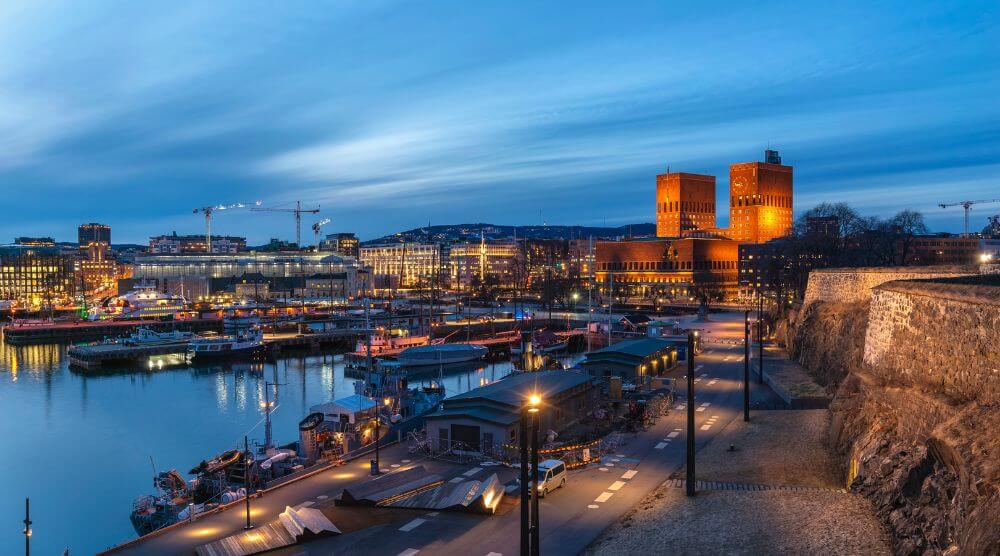
Oslo, Norway‘s capital, has changed more in the past two decades than most European capitals. Its population has grown by over a third, its waterfront has been opened up, and a new generation of museums has opened along the fjord.
This profile looks at how Oslo is positioned, how it is read from outside, and where the two pull apart, drawing on the major rankings alongside our own coverage of the city since 2017.
City Brand Strength
Oslo has climbed steadily in the brand and reputation indices. It moved from the seventies into the top thirty of Resonance’s World’s Best Cities within a few years, while holding a place in the mid-forties of Brand Finance‘s Global City Index.
Oslo chose early on to let the city itself be the brand. Erling Fossen, then CEO of Oslo Metropolitan Area, told us in 2019 that there was no logo and no slogan, only a vision (“the best is yet to come”) and a goal: to be the world’s favourite compact city. His warning to other cities was not to brand alone, without politicians and planners.
Siw Andersen, CEO of Oslo&Co, told us in 2026 that the impression of Oslo abroad is broadly positive but thin. People know it is in the north, that it is green, that it hosts the Nobel Peace Prize and that The Scream was painted there. They do not know its companies or brands, and may not have seen a picture of the city. Oslo&Co was relaunched in 2026 from the former Oslo Business Region to bring investment, talent and international visibility under one roof.
Economic Position
Oslo’s results in the economic rankings are modest for a capital. It has sat in the fifties of the Kearney Global Cities Index and has moved between the thirties and sixties of the Global Financial Centres Index.
The economy behind those numbers has diversified. Andersen describes a city no longer defined by oil and fisheries, with startups in space technology, robotics and AI, investors in climate and health technology, and English as a common working language. Its strongest selling point to investors, in her account, is access: there is little hierarchy, and most business leaders are a phone call away.
Appeal to Talent
Oslo ranks around twentieth in Mercer’s Quality of Living Ranking and among the more expensive cities on the cost indices.
A third of its residents have an international background, which Andersen says outsiders rarely expect of a city they see as homogeneous. The difficulty she names is social: people often move to Oslo with young families, a time when building new friendships is hard, and networks between Norwegians and international residents remain separate.
Urban Sustainability
Sustainability is where Oslo ranks highest. It led the Arcadis Sustainable Cities Index in 2022 and has stayed in its top ten, and it has risen into the top ten of IESE’s Cities in Motion Index.
Oslo was the first city to adopt a climate budget to track and reduce emissions, a model since taken up by London and New York, and it became the first mass market for electric cars. Fossen pointed to the tension that comes with this kind of success: landmark architecture draws visitors, while affordable housing remains the issue that matters most to residents.
What Stands Out
Oslo’s sustainability record and waterfront transformation are known and well documented. What is less known is the city that has grown up around them: more international, more varied in its economy, and closer to nature in daily life than its image suggests.
In TPBO’s reading, Oslo’s task is to fill in a picture that is positive but thin. Andersen names the gap herself: Oslo communicates its achievements well and its everyday life much less.
Oslo&Co promotes a city for business, investment and careers. What people find abroad is the fjord, the Nobel Peace Prize and The Scream.
Sustainability and quality of life are claimed by many cities. What is particular to Oslo is how much nature is part of everyday city life.
Top-ten sustainability rankings and a climate budget copied by London and New York back the claims. The business story has less proof on show.
Positions are relative to the places in TPBO’s editorial record and based on public material only.
Want the same reading for your own place? Request a free Positioning Check →
From Our Archive
- 2026Siw Andersen on how Oslo&Co is shaping the city’s international position
- 2024Arcadis Sustainable Cities Index 2024: top performers and trends
- 2020Robert A. Saunders on screen tourism, nation branding and the Nordic Noir effect
- 2019Erling Fossen on Oslo, building city brand reputation and sustainable urban development
- 2018Tobias Grut on the Nordics region branding challenges and benefits
- 2017Øyvind Såtvedt on brand development and management of the Oslo Region
About this profile. We combine the main international rankings, including Brand Finance‘s Global City Index and Resonance’s World’s Best Cities, with our own interviews and reporting. Rankings change every year, so positions are described in broad terms. See the rankings and indices we follow, or explore our other city profiles.