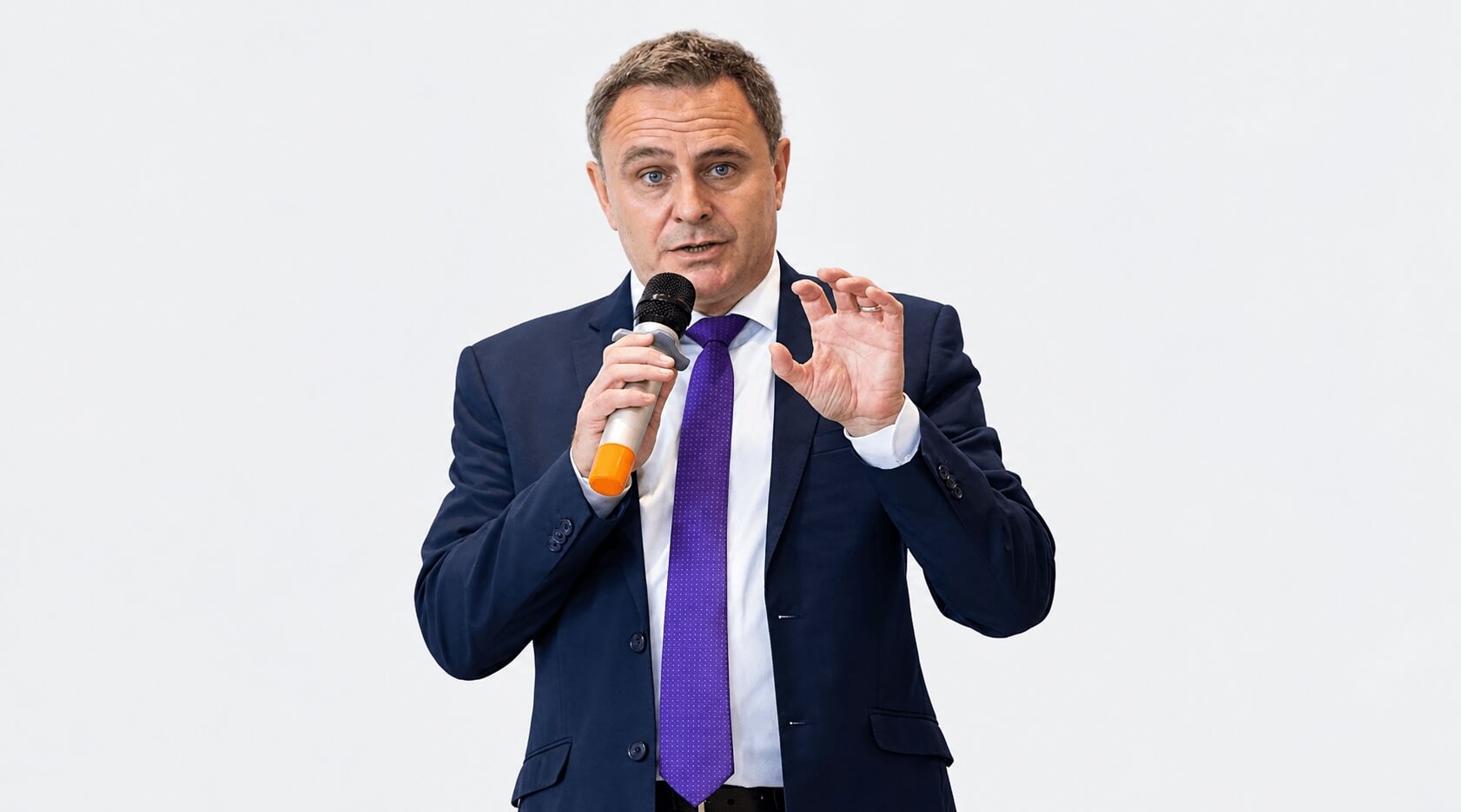
Andrew Keable is Co-Founder and Managing Director of KW Group in Kuala Lumpur. An Asia-Pacific trade and investment expert who specialises in ASEAN, he advises governments and organisations such as the UN, the World Bank, UK FCDO, DFAT Australia and the EU on investment strategy, and helps international companies enter markets across the region. He led the development of Cambodia’s investment promotion strategy.
In this interview, Andrew explains why a place’s image often lags behind what it delivers, how Cambodia should make its case next to Vietnam, why the Johor-Singapore zone is not about who wins, and why Southeast Asia was never anyone’s “plus one”.
Andrew, how did you come to this work, and what does your role as a regional expert on trade and investment for governments and intergovernmental organisations involve?
Originally from the UK, my APAC career began in the private sector, where I was the senior executive responsible for commercial market access and regional growth for Informa’s healthcare exhibitions and intelligence business across Asia-Pacific. From 2005, I supported more than 80 staff across 10 regional offices, with responsibility for helping the business grow across markets. The role gave me first-hand experience of how companies assess opportunities, find customers and build the relationships needed to succeed across borders. That commercial perspective has shaped everything I’ve done since.
In 2011 Michelle Wong and I set up KW Group in Kuala Lumpur. Our work covers three connected areas. We help governments attract investment. We help governments, industry associations and companies with export development and commercial market access, giving companies a commercial roadmap and connecting them with partners, distributors and investors. And we help developing economies build the capability to compete for both.
As a regional expert, I advise governments and organisations such as the UN, the World Bank, UK FCDO, DFAT Australia and the EU, leading government and DFI-funded programmes on investment strategy. In practice, that means helping trade and investment agencies set priorities, shaping national FDI and export strategies and roadmaps, and training the people who have to deliver them. Last year we delivered 24 hours of investment promotion training for Pacific Island countries and trained more than 500 government trade and investment officials across 12 Asia Pacific markets.
The lesson running through all of it is that trade and investment have to be planned together. Investment builds capacity and trade gives it customers. The best agencies stop promoting sectors and start building a small number of projects investors can actually assess that help to build ecosystems.
Our networks in the region are deep and we understand the business cultures. Because we run commercial programmes ourselves, our advice comes from doing the work, not studying it. Our focus is commercial outcomes: export orders, investment decisions, partners signed.
You say reputation is built through delivery. Where in Asia Pacific do you see a place’s image lagging behind what it actually delivers, or running ahead of it? Does narrative play any role at all?
Image still lags delivery more often than it runs ahead. Cambodia is a good example. People picture garments, but from our work on the national investment strategy we see agro-processing and electronics doing much of the heavy lifting.
Where image runs ahead, it’s usually data centres. Thailand built its reputation as a hub very quickly, and in September the government paused 49 data centre projects under construction and 117 awaiting approval while it writes national rules on power, water and land use. One project had gone up next to a Bangkok hospital on a warehouse permit. The story was ahead of the rules behind it.
Narrative does matter, but it’s rarely the problem. We’ve helped a large number of Asia Pacific governments build their investment narratives and value propositions, and more recently their investor-ready projects. The story is usually fine. The gap shows when an investor tests it.
Too many IPAs and EDOs still see themselves as government agencies first. A question on power or land gets passed to the next ministry instead of being answered by government as a whole. And many teams lack the private sector experience to know what an investor actually needs to hear. That’s what holds delivery back, not the narrative.
What’s changing this is competition brought on by geopolitics. With supply chains reacting to tariffs, Middle East conflict and pressures between the US and China, almost every major government now has ASEAN in its growth plan. Austrade has gone furthest, with A$70.2 million for investment deal teams in Singapore, Jakarta and Ho Chi Minh City, and the UK, Canada, Japan, the EU and the Gulf are all stepping up.
Many of the EDOs and IPAs we work with used to see Asia Pacific as China, Japan and Korea. Now they’re putting real time, people and money into ASEAN. That’s raising everyone’s game, with more partnerships, co-financing and new ecosystems around energy, digital and advanced manufacturing. For the region, it’s a hugely positive shift.
You led Cambodia’s investment promotion strategy. What was hardest about that work, and how should Cambodia make its case next to Vietnam?
It was a fantastic project to be part of. The hardest part was alignment. Like most donor-funded strategies, it had many stakeholders. So I treated it as a programme that had to produce a strategy people would actually use, deliberately commercial and outcome-driven, not an academic exercise that ends up on a shelf.
We spent as much time with investors and the private sector as with government. One clear finding was that business wanted regular dialogue with government, not an annual forum. From there we narrowed the focus to the two sectors with the biggest economic impact, agro-processing and electronics, and built a three-year strategy around them, which was presented to the Deputy Prime Minister.
Cambodia is still seen as cheap labour and low-end assembly, and recent regional headlines haven’t helped. I think it’s one of the most underrated locations in Asia today. The median age is around 27. Foreign investors can own 100 percent of a business in most sectors and register a project online, and a business visa can be applied for online and extended in-country. Trade access is strong, with RCEP and bilateral agreements with China, South Korea and the UAE, and Cambodia’s US tariff is capped at 19 percent, just under Vietnam’s 20.
And the infrastructure is catching up fast. Phnom Penh’s new Techo International Airport, designed by Foster + Partners and opened last year, is a work of art and has already won international design awards. It’s a statement of where Cambodia is heading. Sihanoukville port handled a record 1.3 million TEU last year and grew another 38 percent in the first quarter, and a Japanese-backed deep-water terminal opens in early 2027.
So Cambodia shouldn’t try to out-Vietnam Vietnam or Thailand. Its case is as a regional partner that keeps more of the value it creates. Cashew shows why. In 2025 Cambodia exported more than a million tonnes of raw cashew, worth over US$1.5 billion, yet only about 2.4 percent of the crop was processed locally. Most of it crosses into Vietnam and is exported under someone else’s origin. Every processing step Cambodia keeps is value, jobs and brand it currently gives away.
The same logic applies to electronics and auto components, where Cambodia already has 11 vehicle manufacturing and assembly facilities. As companies look for a second site near their plants in Vietnam and Thailand, Cambodia wins by moving up the supply chain, and by being ready with land, power, approvals and export routes the day an investor asks.
In the Johor-Singapore zone, who benefits more? Is there a risk that Johor becomes Singapore’s back office?
It was never really a question of who wins. Singapore and Johor are about a kilometre apart at the Causeway, and around 400,000 people cross the two land links every day. They already work as one economy. The zone formalises it.
We supported MIDA Malaysia on inward investment from Singapore for a number of years, and the reasons companies gave us for expansion in Malaysia were overwhelmingly the same: land availability, labour costs, and the cost of power, water and utilities. Singapore has world-class finance, services and connectivity, but very little land, and it already draws much of its water from Johor. Johor has the space, the people and the resources that manufacturing, AI and data centres need.
English is the common language of business on both sides, and both countries have common law legal systems, so contracts and company structures feel familiar on either side of the Causeway. Each side brings what the other needs, and that’s what makes the partnership so effective. The headquarters, finance and regional leadership might sit in Singapore, while the factory, the data centre and the jobs land in Johor, a kilometre away. Both economies grow, and investors get the best of each.
And it’s delivering. Johor drew RM59.4 billion of approved investment in the first half of 2026, more than a quarter of Malaysia’s RM218.5 billion and second only to Selangor. The Prime Minister puts investment into the zone at RM132 billion from 2025 to June 2026. Singapore was Malaysia’s largest foreign investor in 2025 and second-largest in the first half of 2026. The RTS Link, a five-minute rail crossing that can carry 10,000 passengers an hour in each direction, is in final testing, and the zone’s master plan is due by the end of the year.
The real opportunity now is depth. The question isn’t whether Johor becomes a back office, it’s how quickly local firms move up into these supply chains. The Micron–OCBC supplier event this year, which brought 30 suppliers from South Korea, Japan and Taiwan to explore partnerships with Johor industry, is exactly the right signal. Penang took several decades to grow from an assembly base into a semiconductor ecosystem with its own local champions. Johor has the chance to do it much faster.
For the international companies we work with, the zone is also a market entry point: a base inside ASEAN, with Singapore’s services next door and the region’s customers within reach. And we’re seeing a clear shift. More of the companies we bring into the region no longer assume Singapore has to be their hub. They’re realising that Malaysia is an equally viable base from which to reach regional markets, and for many it’s the better fit for the cost and scale of what they’re building.
Is the “alternative to China” argument losing strength? What do you see in the programmes you run?
Yes, and I’m glad it is. “China plus one” was always a Western way of describing Asia, and a fairly negative one for Southeast Asia. It cast the region as the “plus one”: a hedge or a back-up, rather than a destination valued for what it offers.
The idea peaked around five years ago, when US-China tensions drove every boardroom conversation about the region. We saw it first-hand as international economic development organisations shifted their Asia focus from China towards Southeast Asia. But companies in Asia never saw it as a choice between China and everyone else.
What many observers miss is the scale of what’s being built within the region. Around 60 percent of Asia Pacific’s exports are now traded within Asia Pacific, a market of 4.7 billion people and 60 percent of the world’s population. Investment is following the same path: last year Southeast Asia overtook East Asia, including China, as developing Asia’s largest destination for foreign investment.
That regional trade has also proved remarkably resilient. When China’s exports to the US fell 15 percent in the first eight months of 2025, a matching rise in exports to ASEAN absorbed the drop. ASEAN-China trade passed US$1 trillion that year and has grown another 20.6 percent in the first eight months of 2026, with around two thirds of it in parts, components and production inputs. In our experience, Asian business is conservative and built on long-term relationships. So when tariffs shift and conflict disrupts shipping through the Strait of Hormuz, companies lean on the partners and markets they know.
We see the shift directly in our programmes. This year demand for market access programmes into the region has risen sharply, from Canada, Latin America, the UK, the EU and, most significantly, the Gulf. These governments want growth markets for their exporters that are less exposed to geopolitical swings.
The questions have changed too. The exporters we represent aren’t asking where to move a factory. They are asking for commercial market access: who will buy their product in Vietnam, Australia, or Indonesia, which distributor reaches those buyers, and what the regulator needs. Those are the questions that decide whether a company actually wins business here.
For companies looking at Asia Pacific, and ASEAN in particular, you have to be here to win here. We’ve been running sector briefings for chambers and industry associations on regional ecosystems such as the ASEAN Power Grid and the space sector, and in every session exporters are genuinely surprised by the scale of the opportunities.
For governments and investment agencies across the region, this is the moment to tell that story with confidence. Asia Pacific is the growth market. Land, power, water and labour are available at competitive cost, and more governments are offering policy predictability and clearer, faster regulation at a time when many investors face rising costs and uncertainty elsewhere.
And while many markets are raising barriers, this region is lowering them. Seven economies, Australia, Brunei, Japan, Malaysia, New Zealand, Singapore and Vietnam, sit in both RCEP, the world’s largest free trade agreement, and the CPTPP, which links them to Canada, Mexico, Chile, Peru and the UK. A company based in any of them can reach markets on both sides of the Pacific on preferential terms, and Indonesia, the Philippines and the UAE have now begun talks to join the CPTPP too.
The agencies that back that story with delivery, with investable projects and partners investors can trust, will define how the region is seen for the next decade. After 16 years working here, I’d put it simply: Southeast Asia was never anyone’s plus one.
After 16 years working here, I’d put it simply: Southeast Asia was never anyone’s plus one.
Many places now offer renewable energy for data centres. What makes Sarawak’s case different?
Sarawak is different because it can offer clean power around the clock, and it’s a good example of something bigger. Many of the best opportunities in ASEAN’s energy transition aren’t obvious from outside the region. You find them by working on the ground.
Many renewable energy offers for data centres rest on daytime solar plus certificates that cover consumption at other times. That’s accepted under today’s accounting rules, but the standard is shifting. The GHG Protocol has proposed hourly matching, and leading operators already aim for clean power every hour of the day.
Sarawak can meet that test. Its base is hydro, with an estimated 20,000 MW of potential and a target of 10,000 MW of generating capacity by 2030. A single state-owned utility means one counterparty for long-term supply, and Sarawak is already connecting outwards. Singapore has conditionally approved a 1 GW import of Sarawak power by subsea cable, and a link to Peninsular Malaysia is at study stage.
What most investors don’t see is how much more there is. Sarawak’s own industries, palm oil and agriculture, are opening new opportunities in biomass, biofuels and sustainable aviation fuel, alongside solar, storage and hydrogen.
And Sarawak sits inside a much bigger shift. ASEAN’s energy demand is set to more than double by 2050, and the ASEAN Power Grid connects national grids so power can move from where it’s generated to where it’s needed. The World Bank estimates the region needs around US$800 billion of investment in generation and transmission. The ADB and World Bank have committed US$12.5 billion, and a new project preparation fund backed by Australia, Canada, the EU, Germany and the UK launched in April. Projects are moving too: a second Malaysia-Singapore link of up to 2 GW, a Sumatra to Peninsular Malaysia link under study, and more than 9 GW of approved imports into Singapore.
In our work, we help regional governments and developers turn these opportunities into investor-ready projects, and we brief international governments and chambers on where their exporters fit. Most won’t enter as prime contractors. They’ll come in through specialist packages, Tier 1 supply chains and consortiums, and the window opens well before the tender.
So yes, Sarawak’s case is different. But the bigger lesson for investors and exporters is that ASEAN’s energy opportunities rarely announce themselves. The companies that win will be the ones already on the ground when they take shape.
Who leads the work in Johor, Sarawak and Cambodia?
Strong leadership sets the direction in Johor, Sarawak and Cambodia. But investors judge a place by how effectively that leadership translates into action: clear decisions, coordinated agencies and people who can move a project forward.
Johor has brought federal and state agencies together through a dedicated facilitation centre for the economic zone, which handled 285 investor enquiries in the first five months of this year. In Sarawak, the state has significant influence over the power, land and approvals that matter to energy-intensive investors. In Cambodia, the Council for the Development of Cambodia plays a central role in investment approval and registration.
Across all three, the difference is made by the teams turning policy into progress. Investors need to know who owns a decision, how quickly they can get an answer and whether commitments translate into delivery. That practical coordination is a competitive advantage in its own right.
My view is that investment promotion needs to move beyond selling incentives and broad national ambitions. Governments must articulate what genuinely differentiates their location and develop their strongest ecosystems into credible, investor-ready projects.
Investors don’t invest in a narrative alone. They invest when a compelling proposition is backed by a credible route to delivery.
Thank you, Andrew.
Connect with Andrew Keable on LinkedIn, or learn more about KW Group.
For more perspectives from practitioners and thinkers shaping the future of place, explore our Place Brand Leaders interviews.
This interview is part of our series on investment attraction, on how places make their case to investors. Read more in our Investment Attraction section.