
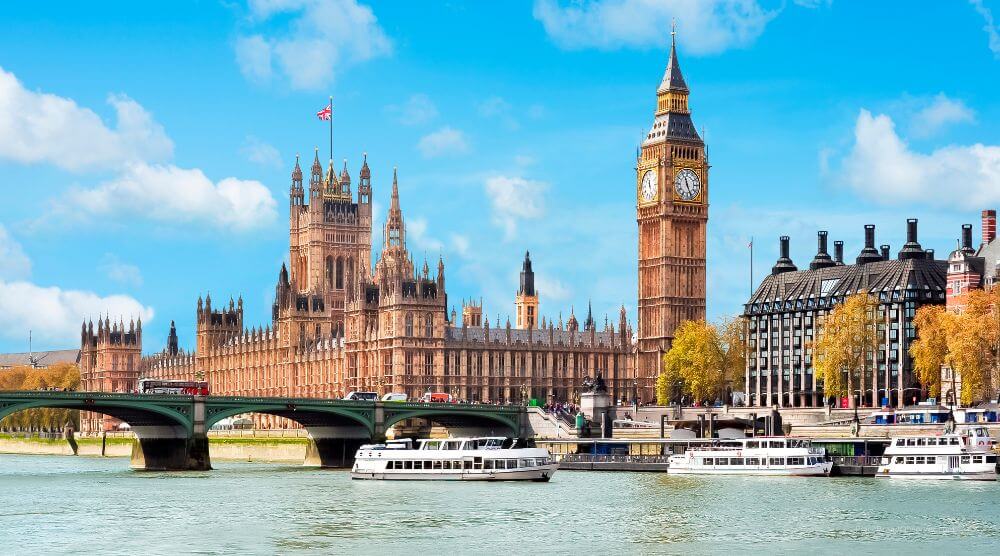
The United Kingdom is one of the best-known countries in the world, with a reputation built on its history, culture, universities and the global role of London. Since 2012 it has promoted itself abroad through one campaign shared across government.
This profile looks at how the UK is positioned, how it is read from outside, and where the two pull apart, drawing on the major rankings alongside our own coverage of the country, its nations and its cities since 2015.
Country Brand Strength
The UK placed seventh in the 2026 Anholt Nation Brands Index, one place lower than the year before. It has long been among the leaders of Brand Finance‘s Global Soft Power Index, and in 2026 Japan moved past it into third place. In Brand Finance’s Nation Brand Value ranking it is fourth, with a value 5% lower than in 2025.
Conrad Bird, Director of the GREAT Britain campaign, told us that GREAT was created around the London 2012 Olympics and coordinated from the Prime Minister’s office, with 23 government departments and organisations working behind one brand. It was set up to be measured by economic return, and in 2016 he aimed for at least £25 back for every £1 spent. He also reminded us that a sophisticated traveller in Los Angeles may not know that London and Scotland are in the same country.
Economic Position
Bloom Consulting ranked the UK first in the world for its trade and investment brand in its 2022-2023 edition. In IMD’s World Competitiveness Ranking it fell from eighteenth in 2021 to twenty-ninth in 2023.
Martin Phelan, who spent more than two decades winning foreign investment for the UK, told us that stable policy across governments has long been one of its strengths, though more recently that has come under challenge. When he asked Spanish investors how they saw the UK, they described great universities, rule of law and a strong financial sector, but also tradition and a slightly old-fashioned country. Few saw it as a technology leader. In his view, GREAT has helped widen that picture by staying consistent for more than a decade.
Appeal to Talent
The UK ranked tenth in INSEAD’s Global Talent Competitiveness Index 2023 and has around ten universities in the global top 100. Cost is the weak point. In the latest QS Best Student Cities ranking, London is third, and no UK city ranks higher than 95th out of 150 on affordability, as our review of five talent rankings found. Expat Insider placed the UK in the bottom quarter overall in 2023.
Sustainability and Quality of Life
The UK ranked second in the Environmental Performance Index 2022 and eleventh in the Sustainable Development Report 2023, while it sits in the high thirties of the Global Peace Index.
Writing just after the Brexit vote, Nigel Morgan expected a short-term hit to the UK’s reputation as an open, diverse country where people want to work and study, and a resilient brand in the medium term. In Liverpool, Chris Brown told us that being European Capital of Culture in 2008 gave the city confidence, and warned that being well known is not the same as being well understood.
What Stands Out
The UK has run one of the most consistent national brand programmes in our record: one campaign across government since 2012, judged by its economic return.
Its reputation remains high, yet most of the indices we follow show it slipping, and the picture held by many investors is still the traditional one Phelan describes. For students and skilled people, cost has become the main obstacle, in a way that a campaign alone cannot change.
The UK promotes technology and innovation. Abroad, it is still read mainly through tradition, universities and finance.
Heritage, culture, universities and London give the UK assets few countries can match. Its technology claims are more widely shared.
Culture, universities and environmental results back the brand. Falling competitiveness and high living costs weaken the message of an open, go-ahead economy.
Positions are relative to the places in TPBO’s editorial record and based on public material only.
Want the same reading for your own place? Request a free Outside View →
From Our Archive
- 2026Martin Phelan on FDI, investment promotion and the future of IPAs
- 2026Investment attraction: six expert views
- 2026Rosanna Vitiello on place identity, emotion and positioning
- 2024Chris Wade on placemaking and place branding in the UK
- 2023Florida Clements on place identity and the Isle of Man
- 2019Christopher Browning on humour, nation branding and identity
- 2018Chris Brown on branding and marketing Liverpool City Region
- 2017How Shrewsbury rediscovered Charles Darwin as a branding opportunity
- 2017Northamptonshire: a county in need of strategic brand management
- 2017Annette Pritchard on tourism, media and destination branding in Wales
- 2017Dominic Medway on the future of UK town centres
- 2017Greg Clark on city branding and urban development
- 2017Gordon Innes on city branding and economic development in London
- 2016Conrad Bird on the GREAT Britain campaign
- 2016Nigel Morgan on destination brands, Brexit and sporting events
- 2015Developing a brand strategy for London Bridge
- 2015Roger Pride on nation and destination branding for Wales
- 2015Malcolm Allan on city branding and placemaking in Great Britain
About this profile. We combine the main international rankings, including Brand Finance‘s Global Soft Power Index and the Anholt Nation Brands Index, with our own interviews and reporting. Rankings change every year, so positions are described in broad terms. See the rankings and indices we follow, or explore our other country profiles.