In May, Brand Finance published its Nation Brand Value ranking for 2026. The main result: the G7 countries together lost US$4.5 trillion in nation brand value in one year. At the same time, smaller countries with a clear economic focus, like Ireland and Denmark, grew.
Now that four major country rankings of 2026 are out, we revisit these results for the bigger picture. In some places all four rankings tell the same story but in others they point in opposite directions. Below we look at the main results, where the rankings agree and disagree, and what it means.
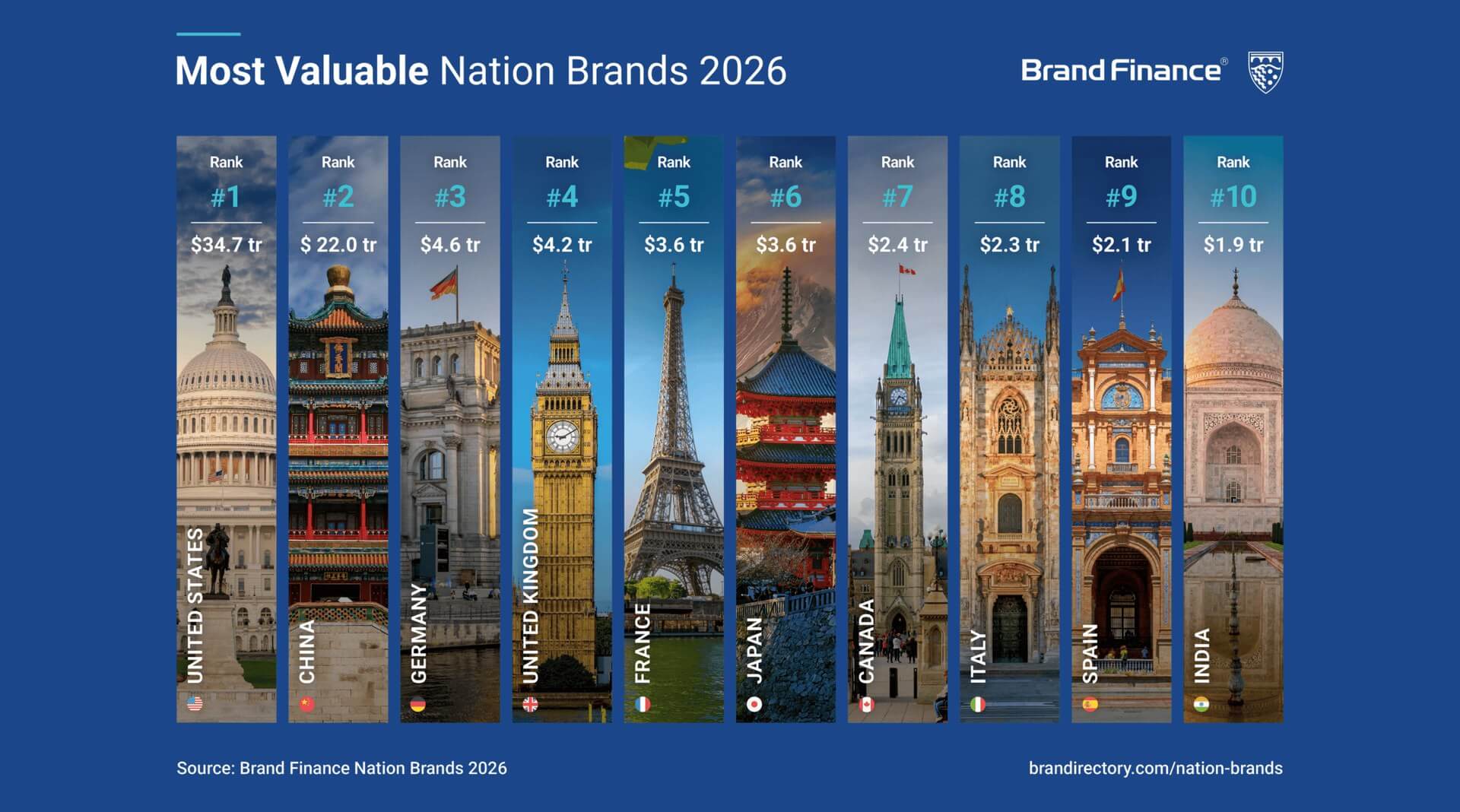
The top 10 most valuable nation brands in 2026 (Brand Finance)
First, a quick look at the Brand Finance ranking on nation brand value:
- United States: US$34.7 trillion
- China: US$22.0 trillion
- Germany: US$4.6 trillion
- United Kingdom: US$4.2 trillion
- France: US$3.6 trillion
- Japan: US$3.6 trillion
- Canada: US$2.4 trillion
- Italy: US$2.3 trillion
- Spain: US$2.1 trillion
- India: US$1.9 trillion
The G7 lost value, China gained
The US is still number one, but its nation brand value fell 7%. Germany lost 8%, the UK 5%, France 7%, Japan 14%, Canada 12% and Italy 4%.
Brand Finance names several reasons: tariffs, geopolitical tension, inflation and high energy costs. It also points to a Western alliance that holds together less well than before.
China moved the other way. Its nation brand value rose by US$1.5 trillion (+7%) to US$22.0 trillion. The gap to the US, now about US$12.7 trillion, became 24% smaller in one year. According to Brand Finance, China managed this by sending its exports to other markets, even with weaker spending at home.
Smaller countries with a clear focus did better
Ireland moved up eight places, with 22% more brand value. Denmark rose four places (+10%). Qatar grew 12%, the UAE 5% and Saudi Arabia 2%.
Brand Finance points to industries that depend less on the ups and downs of the economy: technology, pharmaceuticals, chemicals, logistics and energy. Well-known companies help too. Novo Nordisk stands for Denmark, Emirates for the UAE and Aramco for Saudi Arabia. Ireland hosts the regional headquarters of Apple, Google and Meta.
Better reputation, lower value
A group of emerging economies shows a different pattern. Their Soft Power scores went up, but their nation brand value went down.
Brazil is the clearest example. Its value fell by US$186 billion (-19%) to US$788 billion. Brand Finance sees the same trend in Poland, Vietnam, Pakistan, Argentina, Bangladesh, Romania and Kazakhstan. The reasons are mostly economic: inflation, weak currencies, budget cuts and disrupted trade.
How the Brand Finance ranking works
Brand Finance values countries in a similar way to how it values company brands, using the royalty relief method (ISO 10668). In simple terms, it estimates what a country’s “name” is worth as part of its economic output. Two things drive the result: the size and outlook of the economy, and the strength of the nation brand. Brand strength draws mainly on Brand Finance’s Global Soft Power Index, a large international survey on how people see countries.
See the full Brand Finance ranking on Brandirectory. More about the firm here.
Our reading: looking at the four rankings together
With the Anholt Nation Brands Index released in late October, four major country rankings of 2026 are now out: Brand Finance’s Global Soft Power Index in January, Nation Brand Value in May, Reputation Lab’s RepCore Nations in July and the Anholt Nation Brands Index in October. Read together, they show patterns no single ranking can.
Where they agree. The US lost ground in all four. It had the steepest decline in the Soft Power Index, a weak reputation in RepCore and 7% less brand value. In the Anholt index it fell from 14th to 17th place and dropped out of the top group of countries with the strongest image. When perception and economic value fall together, the signal is hard to ignore.
China is moving the other way. It gained 7% in brand value, recorded one of the largest improvements in RepCore and made the biggest gain of any country in the Anholt index, from 29th to 26th. Its starting point is still low, though: people seem to respect China more than they like it. Denmark is strong in both reputation and value: it sits in RepCore’s top five and grew 10% in nation brand value.
Where they disagree. Japan is the clearest case. It is first in the Anholt index for the fourth year in a row, first in RepCore and third in the Soft Power Index, yet it lost 14% of its nation brand value. Canada is second in RepCore and third in the Anholt index, and lost 12%. Their reputations did not get worse but their economic numbers did.
The reason is in what each ranking measures. The Anholt index, RepCore and the Soft Power Index measure how people see a country. Nation brand value as assessed by Brand Finance starts from the size and outlook of the economy, stated in US dollars. So it reacts quickly to growth forecasts, trade conditions and exchange rates. Reputation moves more slowly.
Two ways to put a price on reputation. This year Anholt also introduced an upgraded analysis within the NBI reporting, called Brand Premium, but it works differently. It first removes the factors that shape any economy, so the size of a country does not decide the result. What is left is the part of the economy linked to a country’s image. By this measure, China’s image has moved from costing its economy money to adding to it: about 0.9% of GDP, or around US$181 billion in 2028.
Our understanding is that Brand Finance asks what a country’s brand is worth within its economy, whereas Anholt asks how much bigger (or smaller) the economy is because of its image.
As Simon Anholt explains, “the NBI Brand Premium can produce a negative result (as was the case with China over many years) if the brand is sufficiently weak, effectively acting as a discount on the country’s activity. The Brand Finance calculation can’t produce a negative number, suggesting that brand value, no matter how weak or negative, can only add value to the economy.”
What to take from this
Read rankings together, not one at a time. When several rankings move in the same direction, take it seriously. When they move apart, check what each one measures before you draw conclusions.
A falling value is not always a reputation problem. Japan shows that a country can be admired and still lose brand value in a difficult economic year. If a country’s value drops, look at the economy first.
Use the value figure for the right audience. A number in dollars might help in conversations with finance and trade ministries. Elsewhere, it might work best next to a perception ranking, so the two tell the full story together.
A clear economic profile and well-known companies help. Denmark combines a strong reputation with companies people know worldwide, and both its rankings went up.
Reputation work takes time, and behaviour counts more than messaging. Brazil and others show that a better image does not turn into value right away. In this year’s report, Simon Anholt adds that he knows of no country that improved its standing through messaging alone. How a country behaves matters more (and that’s something we’ve heard many times over, from leading place branding researchers and pracitioners around the world).
For more on country rankings, explore our Rankings Overview and the Country Observatory.